
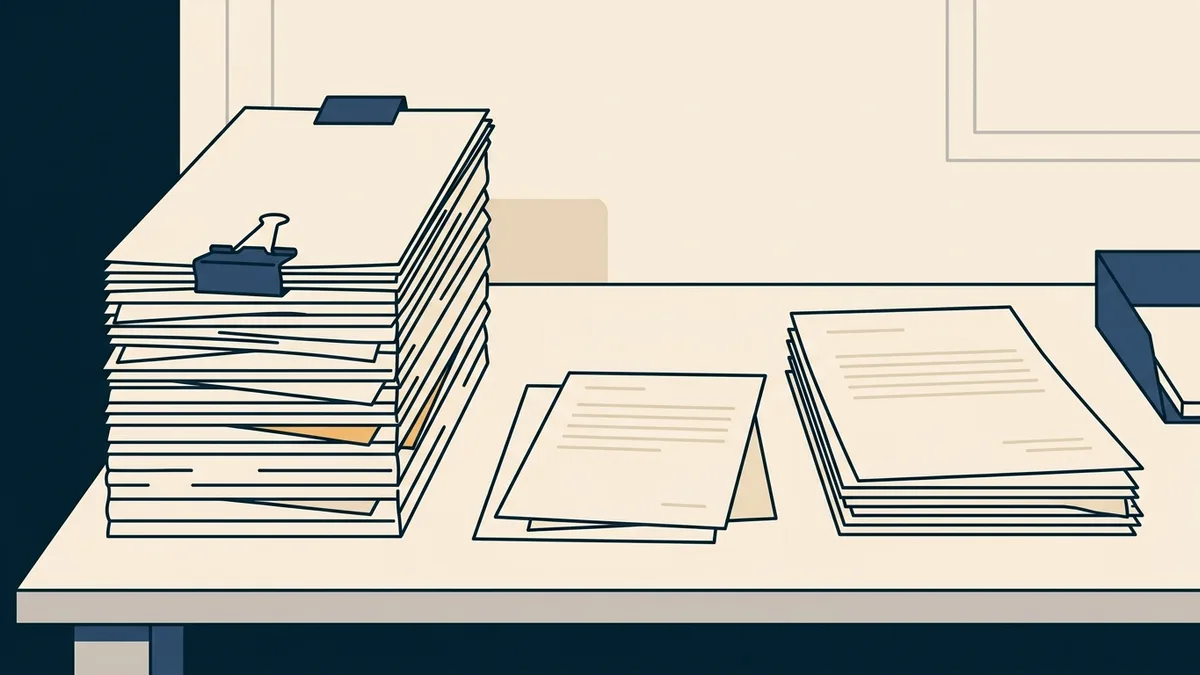
In a state with streamlined endorsement, an experienced licensed applicant usually no longer needs to document graduate coursework or supervised clinical hours. Verification of the current license, background checks, fees and any jurisprudence exam generally remain.
People hear that a state streamlined endorsement and picture an application that has shrunk evenly. It has not. A few specific documents disappear, and they happen to be the ones that made applications take months.
A traditional endorsement file
Application form and fee. Primary source verification from every state that has licensed you. Fingerprinting and criminal background check. National examination score transfer. Jurisprudence examination where the state has one.
Then the heavy section: official transcripts, reviewed course by course against the state's required content areas; catalog descriptions or syllabi when titles are ambiguous; and documentation of postgraduate supervised clinical experience, often on the state's own form, signed by your former supervisor, broken down by client contact hours and individual versus group supervision.
The same file in an adopting state
Application form and fee. Primary source verification. Fingerprinting and background check. Exam score transfer where required. Jurisprudence examination where the state has one.
The heavy section is largely gone. Your unrestricted license, in good standing and held for the required period, stands in for the coursework review and the supervised-hours documentation, because a board already examined both when it licensed you.
Why the removed items were the slow ones
Everything that remains is either within your control or handled by an institution that processes it routinely. Fingerprinting is an appointment. Verification is a request with a fee. A jurisprudence exam is an afternoon.
What was removed depended on documents from the past and people you may not be able to reach. Supervisors retire, move and die. Agencies close and their records scatter. Programs revise their curricula so the syllabus from your year no longer exists. Reconstructing any of that could take longer than the rest of the application combined.
What still catches people
Good standing. The streamlined path depends on your current license being active, unrestricted and free of unresolved matters, including administrative ones such as an unfinished continuing education audit. Check your own verification before the new state does.
Old licenses. Every state that has ever licensed you usually needs to verify, lapsed ones included, and those are the requests applicants forget.
And the exam that survives. Streamlining does not waive a jurisprudence examination, because no other state could have taught you that state's law.
A checklist you can actually use
Before filing in an adopting state, confirm five things. Your current license shows active and unrestricted on its own verification. Every state that has ever licensed you is on your verification request list, including any that lapsed. You know whether the destination requires a jurisprudence exam and whether the score must be on file before submission. Your background check will still be valid when the file completes. And you have held your license for the minimum period the destination's provision requires.
If all five are true, the streamlined application is mostly a matter of waiting on verification. If any is not, fix it first, because each one can quietly move a file off the streamlined path and into individual review.
Common questions
- Which documents does streamlining remove?
- Mainly transcripts reviewed course by course, syllabi or catalog descriptions, and supervised-hours documentation signed by former supervisors.
- Which requirements stay the same?
- Primary source verification of your license, the application and fees, fingerprinting and background checks, and any state jurisprudence exam.
- Is the national exam score still needed?
- Often it is verified, but the score transfer is quick and rarely a bottleneck compared with coursework and supervision records.
Need Help with Your Application?
We handle the MFT licensure process end-to-end — eligibility screening, documents, board follow-ups, and tracking.