
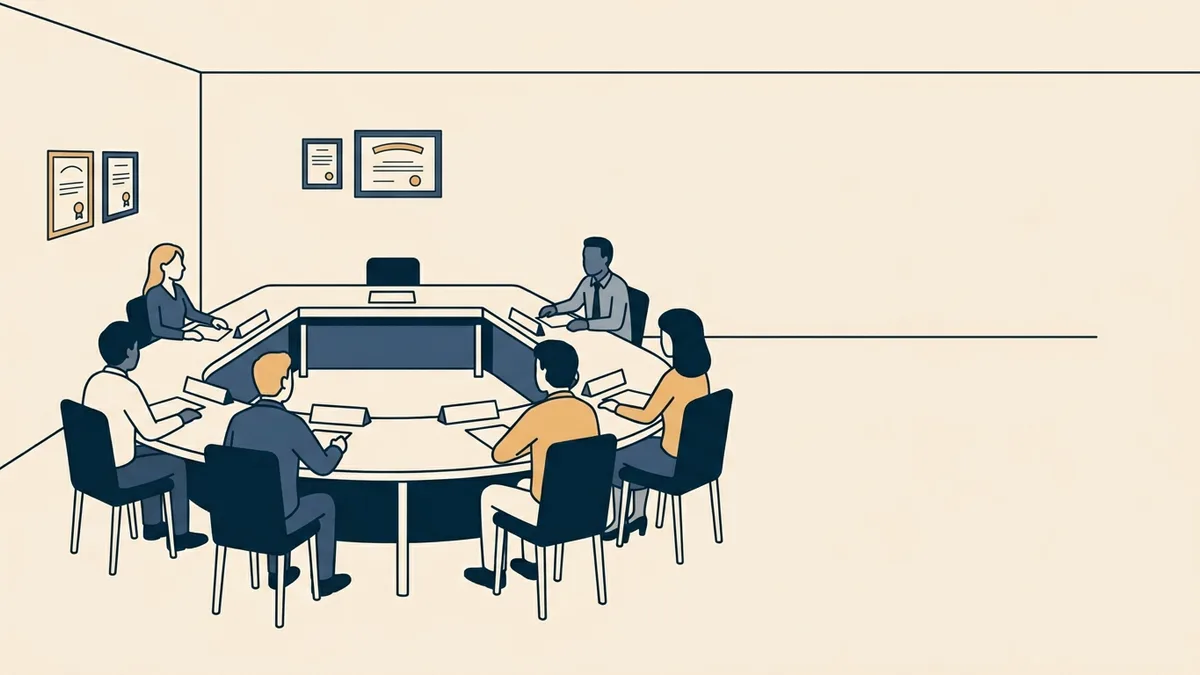
Most licensing boards are made up of licensed practitioners plus at least one public member, appointed by the governor to fixed terms. They are part-time volunteers supported by paid administrative staff who handle day-to-day licensing.
It is easy to picture a licensing board as a remote bureaucracy. In most states it is five to eleven people, most of them practitioners, meeting perhaps quarterly.
The usual composition
A typical board has a majority of licensed members of the profession it regulates, appointed by the governor to staggered fixed terms. Alongside them sit one or more public members who hold no license in the field and are there to represent consumers.
On a composite board covering several professions, seats are usually allocated by profession, which is where marriage and family therapists can find themselves outnumbered. A board licensing counselors, social workers and therapists may seat several of each, and the smallest profession has the fewest votes on rules affecting everyone.
What they actually do
Boards adopt rules, decide disciplinary matters, and rule on applications that fall outside the routine. They do not process ordinary applications; paid administrative staff do that, which is why the person who answers your call is almost never a board member.
This division explains something applicants find puzzling. Staff can tell you what the rules require but cannot waive anything or decide an unusual case. Those go to the board, which may meet only a few times a year, and that meeting schedule is often the real reason an atypical application takes months.
Why the volunteer structure matters
Board members are practitioners with their own caseloads, serving part-time and usually unpaid beyond expenses. They read materials in the evening and meet on days they are not seeing clients.
That has consequences worth understanding rather than resenting. Agendas are finite, so a rule change competes for scarce attention. Vacancies go unfilled for long stretches, and a board short of members may struggle to reach quorum, which delays every decision requiring one. And the members are not specialists in administrative law; they rely heavily on staff and counsel.
It also means the people writing the rules you practice under are people who practice under them.
Influencing the process
Rulemaking includes a public comment period by law in most states. Proposed rules are published, comments are invited, and boards genuinely read them, particularly when a practitioner explains a concrete operational consequence the drafters had not considered.
Comment volume in this profession is low, so a small number of thoughtful submissions can carry real weight. Watch your board's meeting agendas, which are usually posted publicly, and the state's register of proposed rules.
Serving is the stronger version of the same thing. Appointments are made by the governor, vacancies are frequently hard to fill, and professional associations often help identify candidates. If you have opinions about how your profession is regulated, this is the seat where they count.
Common questions
- Are board members state employees?
- Generally no. They are appointed volunteers serving fixed terms, often receiving only expenses. The staff who process applications are employees.
- What does the public member do?
- Represents consumers rather than the profession. Their presence is meant to keep a board from regulating purely in its members' interest.
- Can I become a board member?
- Usually yes, through gubernatorial appointment. Vacancies are often hard to fill, and professional associations frequently solicit candidates.
Need Help with Your Application?
We handle the MFT licensure process end-to-end — eligibility screening, documents, board follow-ups, and tracking.