
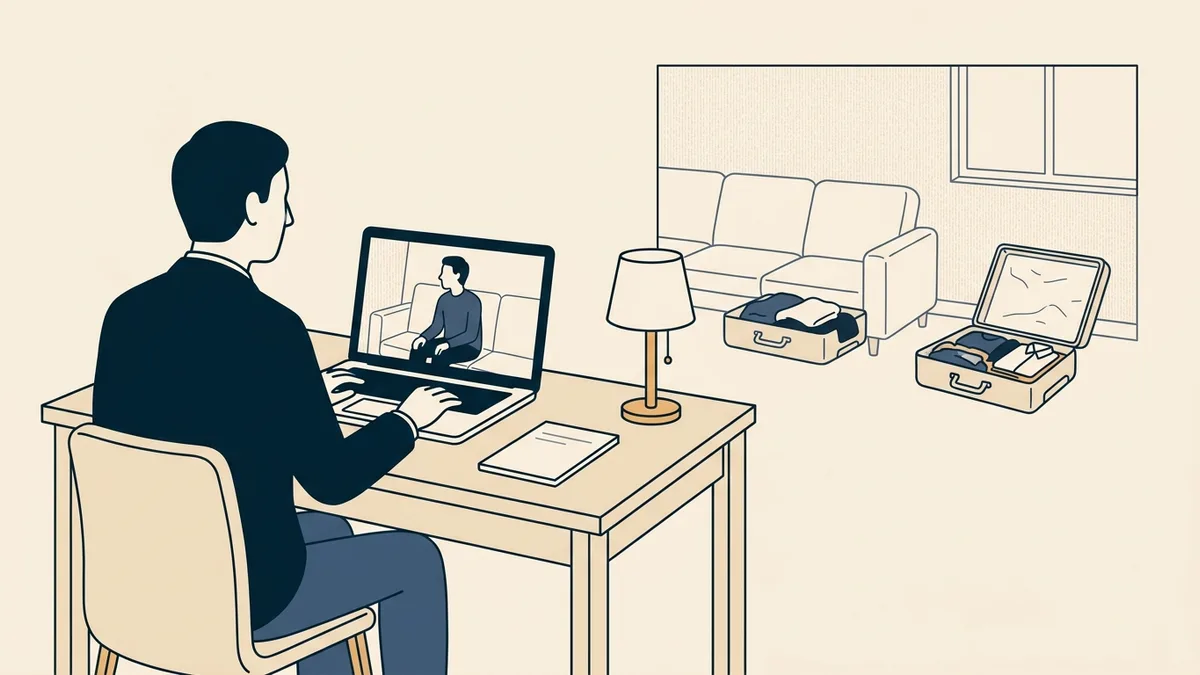
Unlicensed practice happens when you provide therapy to a client physically located in a state where you hold no license. For MFTs it usually happens by accident, through client travel or relocation. It can bring action from the other state and discipline on the license you already hold, so location checks at every session matter.
Almost no marriage and family therapist sets out to practice without a license. The therapists who end up facing that question are usually conscientious people who kept a good clinical relationship going when the client's circumstances changed. The trouble is that licensure law does not care about intent or about how long you have seen the client. It cares about where the client is sitting when the session happens.
Location is the rule that governs
For telehealth, the client's physical location at the time of the session determines which state's law applies and which license you need. Your own location matters for your home state's rules, but it does not substitute for a license where the client is. A therapist licensed only in Ohio who sees a client sitting in a Michigan apartment is practicing in Michigan for that hour.
There is also no shortcut through a compact. MFTs have no interstate compact of their own, and the profession is excluded from PSYPACT, the Counseling Compact, and the Social Work Licensure Compact. AAMFT chose the Access MFTs model law in 2025, which makes endorsement faster in adopting states but still requires a separate license in each one.
Four common ways it happens
Traveling clients are the most frequent source. A couple you see weekly goes to a family reunion out of state and wants to keep their Thursday appointment. A client on a work trip logs in from a hotel. Nobody mentions the location, the video platform looks the same, and the session proceeds.
Relocation is the second. A client moves for a job and asks to continue with you during the transition. Sometimes the plan is a few weeks of bridge sessions while they find a local therapist. Weeks become months, and the therapist has been practicing in a new state for a season without a license there.
College students are a third. A family therapy case includes a young adult who leaves for school in another state and joins sessions by video from a dorm room. Every session with that student present raises the question of the student's location, not just the parents'.
The fourth is practice expansion that outruns paperwork. A group practice adds a telehealth offering, marketing reaches clients in a neighboring state, and intake does not screen for location. Individual clinicians may not even know that some of their new clients live across the border.
Consequences for the license you already hold
The state where the client was located can treat the session as unlicensed practice. Depending on that state's law, possible responses range from a warning letter to fines, cease-and-desist orders, or referral for prosecution in the more serious cases. The details differ by state, and a licensing attorney is the right person to assess exposure in a specific situation.
The larger risk for most clinicians is what happens at home. Many practice acts allow a board to discipline a licensee for violating the laws of another jurisdiction or for conduct that would be unprofessional if it happened locally. A finding in one state can therefore become a complaint in the state where you hold your only license.
Discipline travels. Most license applications, including endorsement applications, ask whether you have ever been the subject of an investigation or action by any board. Streamlined endorsement in the 17 adopting states depends on an active, unrestricted license in good standing, so a restriction or public action can remove you from the faster route for years. When a matter is discovered through verification rather than disclosed, boards treat the nondisclosure more seriously than the original event.
Building location checks into every session
Prevention is mostly a matter of routine. The simplest control is to confirm the client's physical location at the start of every telehealth session and write it in the note. A short script works: ask where the client is right now, including city and state, and record the answer. It takes seconds and creates a record that protects both of you.
Put the expectation in writing at intake. Your telehealth consent can explain that you can only provide services when the client is in a state where you are licensed, that the client must tell you in advance about travel, and that a session may need to be rescheduled or converted to a brief check-in focused on safety and referral if the client is somewhere else.
Ask about travel as part of scheduling. Before holidays, summer breaks, and the start of the academic year, a quick question about upcoming trips surfaces problems while there is still time to plan. For family and couples cases, ask about every participant, since one person joining from another state changes the picture.
Handling relocations and bridge periods
When a client announces a move, start the transition conversation immediately. Find out the move date, the destination state, and whether you hold or could reasonably obtain a license there. If the destination is one of the 17 states with streamlined endorsement and your license is in good standing, getting licensed may be realistic. Otherwise, the plan is usually a well-documented referral to a clinician licensed in the new state, with sessions ending before the client leaves or continuing only while the client is still physically in your state.
Some states offer temporary practice allowances or short-term permits for out-of-state clinicians. They vary in length, in whether they require advance notice or registration, and in whether they apply to MFTs at all. Do not rely on one based on a colleague's description. Read the rule on the board's site and confirm it with the board or an attorney before the first session.
Group practices and supervisors
In a group practice, location screening should be built into scheduling software and intake forms, not left to each clinician's memory. Assign clients to clinicians based on licensure, and keep a current list of which clinicians hold which licenses with expiration dates. Supervisors should also check that supervisees are not seeing clients located in states where neither of them can lawfully provide or supervise services.
If it has already happened
Stop providing services into the unlicensed state, keep accurate records, and talk to a licensing attorney before making any statements to a board. The attorney can help you decide whether and how to disclose and how to answer future application questions truthfully. The one approach that reliably makes things worse is hoping it never comes up.
Common questions
- Can I be disciplined by my home board for a session in another state?
- Possibly. Many boards treat a violation of another jurisdiction's law, or conduct that would be unprofessional at home, as grounds for their own action. Whether your board would act depends on its statute and rules, so ask a licensing attorney if the question is live for you.
- Does a single session really count as practice?
- Most practice acts do not set a minimum number of sessions before the law applies. Some states offer temporary or limited practice allowances, but they are specific and often require notice or registration first. Assume one session counts unless the board confirms otherwise in writing.
- What should I do if I discover I already practiced into another state?
- Stop providing services into that state, document what happened, and speak with a licensing attorney before contacting any board. Do not hide it on later applications. Undisclosed matters found through verification are treated more seriously than the original issue.
- Is there a compact that would make this legal?
- No. There is no MFT interstate compact, and MFTs are excluded from PSYPACT, the Counseling Compact, and the Social Work Licensure Compact. You need a license in each state where your clients are located during sessions.
Need Help with Your Application?
We handle the MFT licensure process end-to-end — eligibility screening, documents, board follow-ups, and tracking.